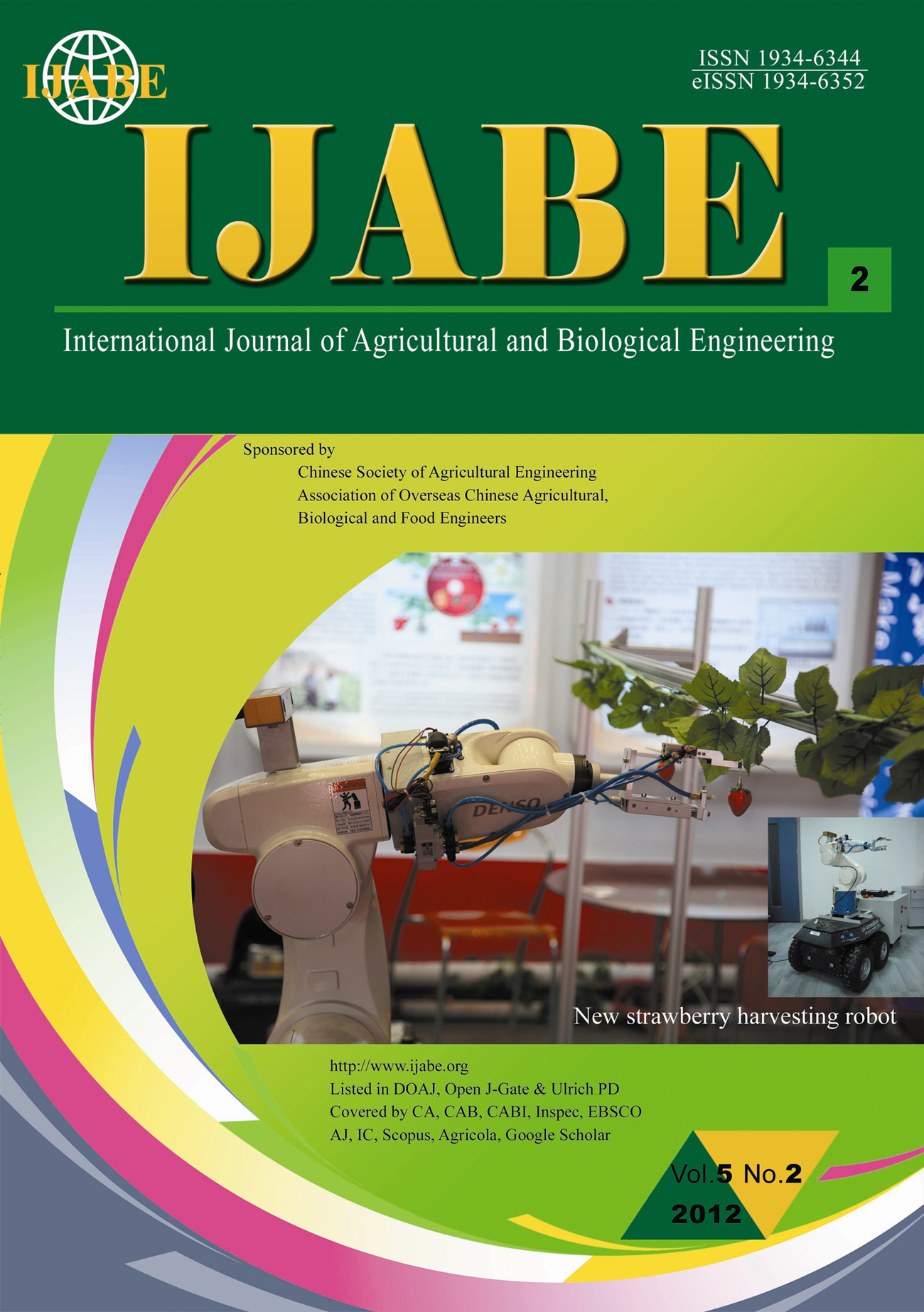
New strawberry harvesting robot for elevated-trough culture
Keywords:
strawberry harvesting robot, elevated-trough culture, machine vision, nondestructive end-effector, autonomous navigation system, manipulator, sensorAbstract
Feng Qingchun*, Wang Xiu, Zheng Wengang, Qiu Quan, Jiang Kai (National Engineering Research Center for Information Technology in Agriculture, Beijing 100097, China) Abstract: In order to improve robotic harvesting and reduce production cost, a harvesting robot system for strawberry on the elevated-trough culture was designed. It was supposed to serve for sightseeing agriculture and technological education. Based on the sonar-camera sensor, an autonomous navigation system of the harvesting robot was built to move along the trough lines independently. The mature fruits were recognized according to the H (Hue) and S (Saturation) color feature and the picking-point were located by the binocular-vision unit. A nondestructive end-effector, used to suck the fruit, hold and cut the fruit-stem, was designed to prevent pericarp damage and disease infection. A joint-type industrial manipulator with six degrees-of-freedom (DOF) was utilized to carry the end-effector. The key points and time steps for the collision-free and rapid motion of manipulator were planned. Experimental results showed that all the 100 mature strawberry targets were recognized automatically in the harvesting test. The success harvesting rate was 86%, and the success harvesting operation cost 31.3 seconds on average, including a single harvest operation of 10 seconds. The average error for fruit location was less than 4.6 mm. Keywords: strawberry harvesting robot, elevated-trough culture, machine vision, nondestructive end-effector, autonomous navigation system, manipulator, sensor DOI: 10.3965/j.ijabe.20120502.001 Citation: Feng Q C, Wang X, Zheng W G, Qiu Q, Jiang K. New strawberry harvesting robot for elevated-trough culture. Int J Agric & Biol Eng, 2012; 5(2): 1References
Hayashi S, Shigematsu K, Yamamoto S, Kobayashi K, Kohno Y, Kamata J, et al. Evaluation of a strawberry-harvesting robot in a field test. Biosystems Engineering, 2010; 105: 160-171.
Shiigi T, Kurita M, Kondo N, Ninomiya K, Rajendra P, Kamata J,et al. Strawberry harvesting robot for fruits grown on table top culture. 2008 ASABE Annual International Meeting, 2008; Paper Number: 084046.
Arima S, Kondo N, Monta M. Strawberry harvesting robot on table-top culture. 2004 ASABE/CSAE Annual International Meeting, 2004; Paper Number: 043089.
Kondo N, Ninomiya K, Hayashi S, Ota T, Kubota K. A New Challenge of robot for harvesting strawberry grown on table top culture. 2005 ASABE Annual International Meeting, 2005; Paper Number: 053138.
Jiang H Y, Peng Y S, Ying Y B. Measurement of 3-D locations of ripe tomato by binocular stereo vision for tomato harvesting. 2008 ASABE Annual International Meeting, 2008; Paper Number: 084880.
Tarrío P, Bernardos A M, Casar J R, Besada J A. A harvesting robot for small fruit in bunches based on 3-D stereoscopic vision. Computers in Agriculture and Nature Resources, ASABE 4th World Congress Conference, 2006; Publication Number: 701P0606.
Van Henten E J, Van Tuijl B A J, Hemming J, Kornet J G, Bontsema J, Van Os E A. Field test of an autonomous cucumber picking robot. Biosystems Engineering, 2003; 86(3): 305-313.
Xu L M. Study on strawberry harvesting system. Ph.D dissertation. Beijing, China Agricultural University, 2006. (In Chinese with English abstract)
Chen L B. Study on Picking System for Strawberry Harvesting Robots. Ph.D dissertation. Beijing, China Agricultural University, 2005. (In Chinese with English abstract)
Zhang K L, Yang L, Zhang T Z. Design of an End-effector for Strawberry Harvesting Robot. Journal of Agricultural Mechanization Research, 2009(4): 54-56. (In Chinese with English abstract)
Xie Z Y, Zhang T Z, Zhao J Y. Ripened Strawberry Recognition Based on Hough Transform. Transactions of the Chinese Society for Agricultural Machinery, 2007; 38(3): 106-109. (In Chinese with English abstract)
Downloads
Published
How to Cite
Issue
Section
License
Copyright (c) 2012 International Journal of Agricultural and Biological Engineering

This work is licensed under a Creative Commons Attribution 4.0 International License.
IJABE is an international peer reviewed, open access journal, adopting Creative Commons Copyright Notices as follows.
Authors who publish with this journal agree to the following terms:
- Authors retain copyright and grant the journal right of first publication with the work simultaneously licensed under a Creative Commons Attribution License that allows others to share the work with an acknowledgement of the work's authorship and initial publication in this journal.
- Authors are able to enter into separate, additional contractual arrangements for the non-exclusive distribution of the journal's published version of the work (e.g., post it to an institutional repository or publish it in a book), with an acknowledgement of its initial publication in this journal.
- Authors are permitted and encouraged to post their work online (e.g., in institutional repositories or on their website) prior to and during the submission process, as it can lead to productive exchanges, as well as earlier and greater citation of published work (See The Effect of Open Access).